

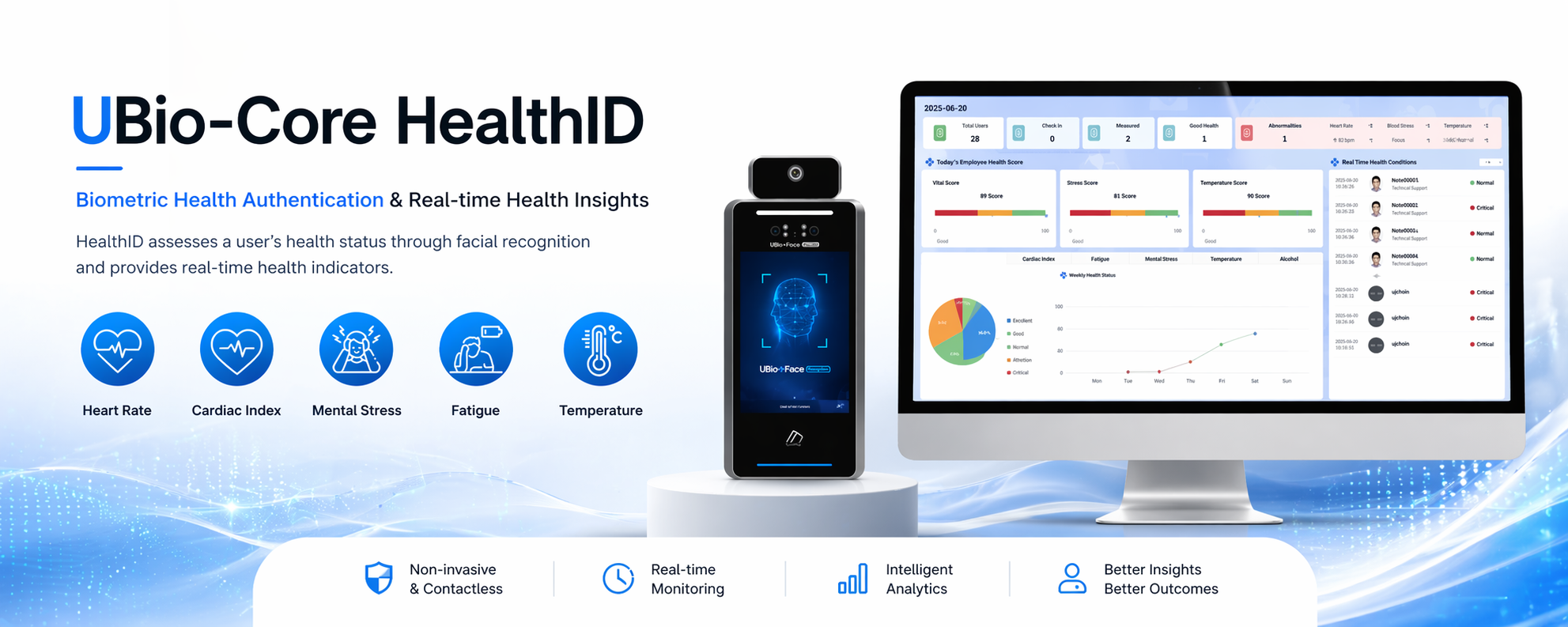
This article breaks down the UBio-Core HealthID and its rPPG-based contactless health monitoring system to help you decide whether it belongs at the entry points of your next construction or industrial project. You will find a detailed look at its core technology, integration with the UBio-Alpeta platform, real-world workflow impact, and how it compares to traditional safety monitoring approaches used across the UAE.
What Is the UBio-Core HealthID?
The UBio-Core HealthID is a biometric health authentication solution its a contactless vital sign monitoring device developed for high-risk work environments where employee health directly affects operational safety. Built around rPPG technology, which stands for Remote Photoplethysmography, this device uses a standard camera sensor to read physiological data from a worker’s face without requiring any wearable device or physical contact. It measures heart rate, respiratory rate, blood oxygen saturation (SpO2), stress levels, fatigue indicators, and even heat stroke risk, all within a single ten-second scan.
Designed by UBio and powered by the UBio-Alpeta management platform, the HealthID targets industries such as construction, oil and gas, manufacturing, and logistics, where dusty, hot, and high-traffic environments make traditional health monitoring difficult or impractical. The device is engineered to sit at entry checkpoints, functioning as a gatekeeper that determines whether a worker is physically fit to enter a site. This concept, often referred to as “Safe to Work” verification, represents a shift from reactive safety compliance to proactive risk mitigation.
The system is certified at 97 percent precision for its vital measurements, positioning it at a medical-grade reliability threshold that makes it viable for daily operational decisions. Rather than relying solely on subjective self-reporting or periodic medical check-ups, the UBio-Core HealthID provides objective, real-time data every time a worker approaches a controlled entry point.
Key Feature: rPPG Technology for Contactless Vital Monitoring
The standout capability of the UBio-Core HealthID is its use of rPPG technology to extract vital signs from subtle skin colour changes captured by the device’s camera. When blood pulses through the capillaries beneath the skin’s surface, it causes imperceptible colour variations that standard cameras can detect when paired with advanced algorithmic processing. The HealthID leverages this principle to measure six critical health parameters without touching the worker at all.
This approach eliminates the hygiene concerns, time delays, and equipment maintenance issues associated with contact-based monitoring devices. In environments like construction sites across Dubai and Abu Dhabi, where hundreds of workers may pass through a single checkpoint during a morning shift, the ability to complete a full vital scan in approximately ten seconds is transformative. There is no need to attach sensors, calibrate wearables, or wait for readings. The worker simply stands before the device, and within seconds, the system delivers a comprehensive health snapshot.
The six vital parameters monitored include
Heart rate measurement through facial skin colour variation analysis using the rPPG camera sensor.
Respiratory rate detection to identify workers who may be experiencing breathing difficulties or respiratory distress before they enter hazardous zones.
Blood oxygen saturation (SpO2) tracking, which is especially critical in hot climates where dehydration and heat exposure can silently reduce oxygen levels.
Stress level assessment to flag workers who may be in a compromised mental state, increasing accident risk in high-stakes environments.
Fatigue detection that helps supervisors identify workers who may not have had adequate rest, a leading contributor to workplace incidents.
Heat stroke risk evaluation, a parameter particularly relevant to the UAE’s extreme summer conditions where outdoor labour is most vulnerable.
The 97 percent precision certification means site managers can trust the data for making access decisions without second-guessing the readings. This is not a consumer wellness gadget; it is an industrial health screening tool designed to prevent incidents before they happen.
Key Feature: Firmware-Based Deployment on Existing Biometric Hardware
One of the most operationally significant advantages of the UBio-Core HealthID is how it is delivered. Unlike competing health monitoring solutions that require organisations to procure, install, and commission entirely new hardware, the HealthID is implemented as a firmware update on compatible existing UNION biometrics access control terminals. This means facilities that already have UBio devices deployed at their entry points can activate full rPPG-based vital sign monitoring without replacing a single unit.
For procurement and operations teams, this distinction matters considerably. There is no capital expenditure on new scanning hardware, no extended installation timeline, and no disruption to existing access control workflows. The update is applied to the terminal, and the health screening capability becomes available immediately alongside the biometric authentication functions already in use.
This approach is particularly well-suited to large construction contractors and facility management companies in the UAE that have already invested in biometric access control infrastructure across multiple sites. Rather than treating the HealthID as a parallel system requiring its own rollout, these organisations can treat it as a capability expansion of their existing security layer. The result is faster deployment, lower total cost of ownership, and a significantly reduced barrier to adoption compared to hardware-first health monitoring solutions.
Core Feature: UBio-Alpeta Platform Integration
While the HealthID device captures data at the point of entry, its true operational power emerges when connected to the UBio-Alpeta platform. This cloud-based management system transforms individual health scans into a site-wide safety intelligence layer that supervisors, safety officers, and project managers can use to make informed decisions in real time.
The UBio-Alpeta platform aggregates health data from every HealthID device deployed across a site or across multiple sites. It provides a centralised dashboard where managers can view individual worker health trends, identify patterns across teams or shifts, and set automated rules that determine site access based on health thresholds. For example, if a worker’s SpO2 reading falls below a configured threshold, the system can automatically deny entry and flag the worker for medical evaluation, all without requiring human intervention at the checkpoint.
This integration extends beyond health monitoring into access control. The UBio-Alpeta platform ties health verification directly to physical access systems, meaning a worker cannot badge through a turnstile or gate unless they have passed their health screening. This “Safe to Work” verification model ensures that every person on site has been objectively assessed that day, creating an auditable trail of compliance that satisfies both internal safety standards and regulatory requirements.
The dashboard also supports trend analysis, allowing safety officers to spot recurring issues. If a particular crew consistently shows elevated stress or fatigue levels, management can investigate root causes such as scheduling practices, workload distribution, or environmental factors. Over time, this data becomes a strategic asset for improving overall workforce health and operational efficiency.
Who Should Buy the UBio-Core HealthID in the UAE
The UBio-Core HealthID is built for organisations where worker health directly correlates with operational safety and business continuity. It is not a general-purpose wellness device; it is a purpose-built industrial health screening system.
Construction companies operating large-scale projects in Dubai and Abu Dhabi stand to benefit the most. These sites employ hundreds or thousands of workers who perform physically demanding tasks in extreme heat, making real-time health screening at entry points a practical necessity rather than a luxury. The ability to detect heat stroke risk, fatigue, and low oxygen saturation before a worker steps onto a scaffold or operates heavy machinery addresses the root cause of many preventable workplace incidents.
Oil and gas operators in the UAE, where safety standards are among the strictest in the world, will find the HealthID’s automated compliance documentation particularly valuable. The auditable trail of daily health screenings satisfies regulatory requirements while reducing the administrative burden on safety officers.
Logistics and warehousing companies managing large workforces across multiple shifts can use the system to monitor fatigue patterns and adjust scheduling practices based on objective data rather than guesswork.
Facility management companies responsible for multiple properties will appreciate the multi-site dashboard capability, allowing centralised oversight without deploying dedicated safety personnel at every location.
Government entities and semi-government organisations in the UAE that are responsible for large infrastructure projects or public works can use the system to enforce health and safety standards across contractor workforces, ensuring consistent screening regardless of which subcontractor is providing the labour.
UBio-Core HealthID vs Traditional Safety Monitoring: Which One Is Right for Your Use Case
The decision between implementing the UBio-Core HealthID and continuing with traditional safety monitoring methods comes down to whether your organisation wants to prevent incidents or simply respond to them after they occur. Traditional approaches such as PPE enforcement, periodic medical check-ups, and manual supervisor observations have served the industry for decades, but they operate on a fundamentally reactive model.
Feature, UBio-Core HealthID, Traditional Safety Monitoring
Core Technology, rPPG contactless camera-based vital scanning, Manual observation and periodic medical exams
Authentication Method, Facial scan with automated health verification, Visual PPE checks and manual sign-in
Monitoring Frequency, Every entry point visit with daily real-time data, Periodic check-ups ranging from weekly to annually
Key Health Parameters, Heart rate respiratory rate SpO2 stress fatigue heat stroke risk, Basic vitals during scheduled exams only
Response Time, Immediate automated denial of entry if thresholds are breached, Delayed response dependent on supervisor observation
Software Integration, UBio-Alpeta platform with dashboard automation and access control, Paper records or basic spreadsheet tracking
Compliance Documentation, Automated auditable digital trail, Manual record keeping with higher error risk
Best For, High-risk industrial sites requiring proactive daily health screening, Low-risk environments with stable workforces and minimal heat exposure
The UBio-Core HealthID fundamentally changes the safety conversation from “did everyone wear their hard hat” to “is everyone physically capable of working safely today.” Traditional monitoring relies on the assumption that if a worker shows up and puts on their PPE, they are fit for duty. The HealthID challenges that assumption by providing objective physiological data that reveals hidden risks like dehydration, sleep deprivation, or cardiovascular stress that no hard hat can protect against.
For site managers in the UAE, where summer temperatures routinely exceed 45 degrees Celsius and outdoor labour is a daily reality, the heat stroke risk detection alone justifies serious consideration. Traditional methods might catch a worker showing visible signs of heat exhaustion, but by that point, the situation is already a medical emergency. The HealthID catches the physiological precursors during the morning scan, before the worker ever reaches the job site. Organisations that have adopted proactive monitoring tools consistently report reduced incident rates and lower workers’ compensation costs, while also demonstrating a measurable commitment to workforce welfare that strengthens their position in contract bids and regulatory audits.
What Is the UBio-Core HealthID Price in UAE and Where Can You Buy It
The UBio-Core HealthID is available in the UAE through authorised channels that can provide detailed specifications, deployment planning support, and after-sales service. Pricing is available on request through etopme.ae, along with current availability, bundle options, and full UAE warranty support.
Given the specialised nature of this product and the importance of proper installation and integration with the UBio-Alpeta platform, it is essential to work with a knowledgeable seller who can assess your site requirements and recommend the correct number of units and configuration. Always purchase from an authorised seller to ensure valid UAE warranty and after-sales support.
Frequently Asked Questions
What is the UBio-Core HealthID price in UAE?
The UBio-Core HealthID pricing depends on deployment scale, site configuration, and integration requirements. Pricing details are available on request through etopme.ae, where you can also get guidance on the right setup for your specific project needs.
Where can I buy the UBio-Core HealthID in Dubai?
The UBio-Core HealthID is available through etopme.ae, which serves customers across Dubai, Abu Dhabi, and the wider UAE. The team can assist with product selection, deployment planning, and ongoing technical support.
Does the UBio-Core HealthID come with UAE warranty?
Warranty coverage is provided when purchasing through authorised channels in the UAE. For specific warranty terms and conditions, it is best to confirm directly through etopme.ae at the time of purchase.
Is the UBio-Core HealthID better than traditional safety monitoring?
The HealthID addresses a fundamentally different layer of safety compared to traditional methods. While PPE and manual inspections remain necessary, they do not detect hidden physiological risks like fatigue, stress, or declining oxygen levels. The HealthID adds a proactive screening layer that catches these issues before a worker enters the job site, making it a complement to rather than a replacement for existing safety protocols.
What is included with the UBio-Core HealthID?
The UBio-Core HealthID includes the scanning device and access to the UBio-Alpeta management platform. Specific package contents including mounting hardware, software licenses, and any additional accessories should be confirmed through etopme.ae based on your deployment requirements.
How accurate is the UBio-Core HealthID for vital sign measurement?
The device is certified at 97 percent precision for its vital sign measurements, which places it at a medical-grade reliability level suitable for making daily access control decisions in industrial settings.
Can the UBio-Core HealthID be deployed across multiple sites?
Yes, the UBio-Alpeta platform supports multi-site deployment with a centralised dashboard. This allows safety directors and project managers to monitor workforce health data across all connected sites from a single interface, regardless of geographic location within the UAE.
Ready to see the UBio-Core HealthID in action?
Contact our expert team to request a demo, get a product specification sheet, or discuss your access control requirements in detail.